


By Andrew Harrison, Hardware Engineering Manager, Emesent

When we started work on what would become Emesent GX1, our first instinct wasn't to look at what competitors were building. It was to listen — really listen — to the people who would actually use it.
Over the course of GX1's development, we spoke with more than 25 surveyors, survey business owners, engineers and geospatial professionals from around the world. We asked about their workflows. We recorded their frustrations, their workarounds, and their wish lists. What emerged wasn't a spec sheet - it was a clear picture of what a mobile scanner built for professional surveyors should actually look like.
This is that story.
1. Emesent SLAM: Accuracy That Earns Trust
The feedback we heard most consistently, and most emphatically, was about accuracy. Surveyors weren't just looking for faster scanning - they needed data they could stake their professional reputation on.
Emesent SLAM had already been proven in the world's most demanding environments - navigating autonomous drones through GPS-denied underground mines where failure simply wasn't an option. For GX1, we doubled down on that foundation. We upgraded our sensor suite and optimized the field of view for maximum SLAM feature detection, and made pioneering improvements to the algorithm itself - including enhanced accuracy, reduced drift, and improved repeatability. The result is 5–10mm global accuracy with GCPs: the most accurate mobile scanner we've ever built.
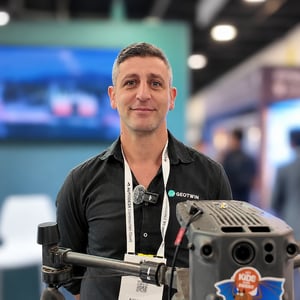
“When we say that it’s 10 meters, how close is that 10 meters to the real world?” Garry Elali, Geotwin
2. Integrated RTK: Real-Time Confidence in the Field
We took a deliberate decision early in GX1's development: RTK had to be built in from the ground up, not bolted on as an afterthought. For surveyors — unlike the mining industry that Emesent's technology was originally built for — RTK isn't optional. It's a fundamental part of how they work.
Previously, getting RTK into a mobile scanning workflow meant managing a separate receiver, separate charging, separate configuration, and a more complex setup before a single scan could be taken. We wanted to eliminate that entirely.
The GX1 incorporates a premium 448-channel RTK receiver directly into the scanner, with NTRIP configuration handled through Commander and live RTK quality monitoring visible throughout the scan. One device, one ecosystem, one workflow.
3. 4 x 20MP Integrated Cameras: Image Quality That Matches the Data
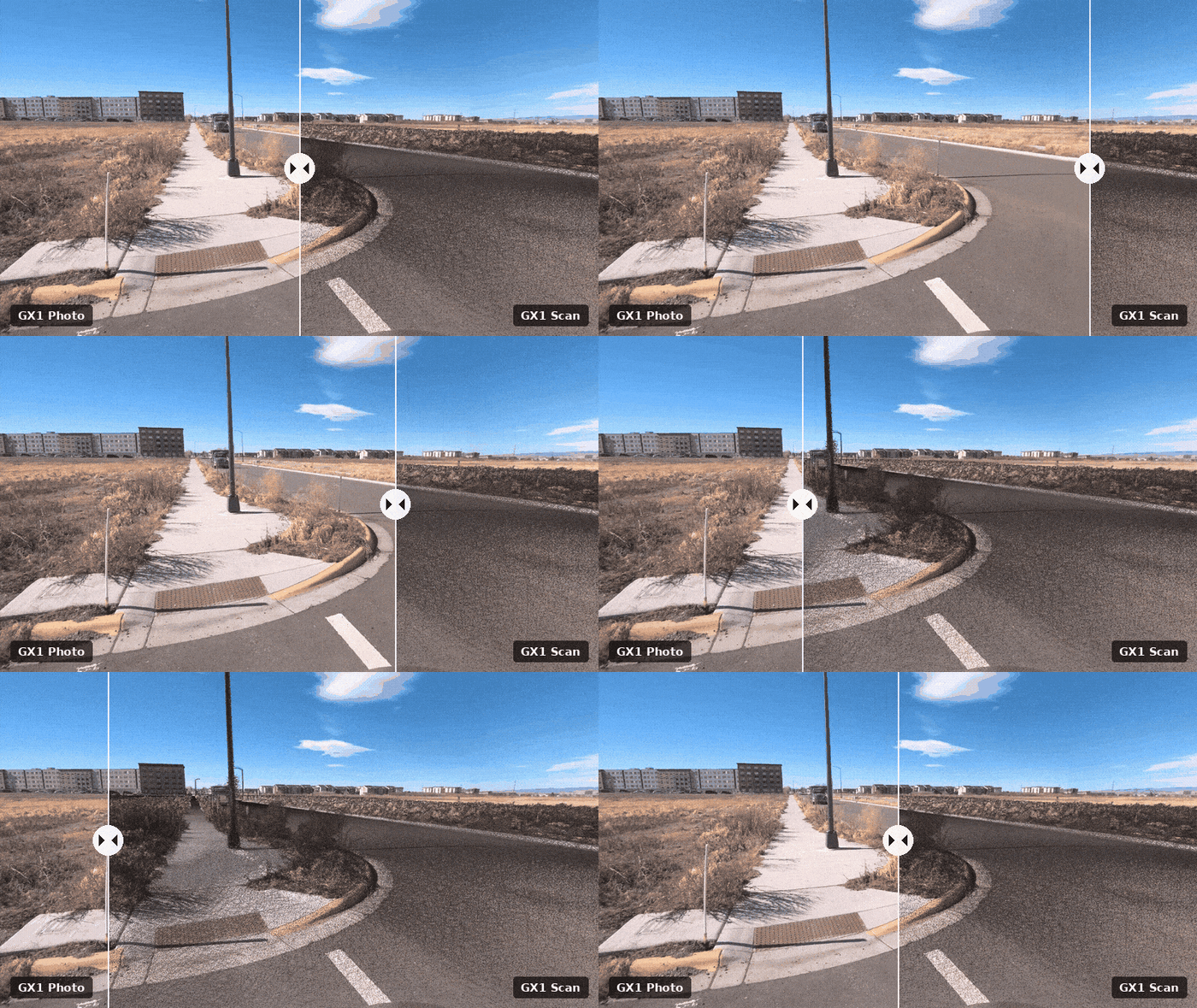 Colorization and image quality were another area where we knew we had to raise the bar. Surveyors are increasingly asked to deliver not just point clouds, but rich, detailed visual records - for BIM projects, asset documentation, and client reporting. Grainy, poorly lit imagery simply wouldn’t cut it.
We made some challenging trade-offs here: balancing sensor size with low-light performance, choosing rolling shutter compensation for high resolution and better color representation.
The result is four 20MP cameras delivering a 360-degree horizontal, 142-degree vertical field of view and ground sample distance of 0.96mm per pixel at one meter. Even in challenging lighting conditions, GX1 delivers exceptional imagery and colorized point clouds.
4. 360-Degree LiDAR Field of View: More Features, Less Drift
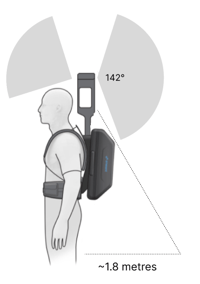 One of the less visible but more consequential decisions we made was around the LiDAR drive system and the stacked form factor. By positioning the LiDAR at a 45-degree angle and enabling a full 360-degree horizontal field of view, GX1 sees significantly more of the environment while scanning, enabling SLAM to generate more features - which directly translates to lower drift and higher accuracy.
This wasn't just an engineering preference. Our users told us that accuracy degradation in large or open outdoor environments was a real limitation of scanners they'd tried. The stacked form factor, while a departure from point-and-shoot handheld designs, was the right call for data quality - and for creating a product that is visually and functionally distinct from "indoor SLAM" competitors.
"[Other SLAM scanners] can do a building scan okay, but when I need to do indoor + outdoor, they have problems." — Bruce Lin, Lin Trading
5. Four Mounting Methods: One Scanner, Any Project
Surveyors don't work in one environment. They're on highways one week, in buildings the next, and underground the week after that. A scanner that only works well in one configuration isn't fit for professional use, nor a scalable solution for businesses looking to grow.
We designed GX1 to deploy four ways: an adjustable-height ergonomic backpack for general-purpose scanning, a survey pole compatible with standard 5/8" thread for stable, precise work, a vehicle mount for large-area road surveys, and a supported handheld harness for cramped or complex indoor environments. Each mounting method was tested extensively with field professionals - and iterated on based on real feedback. For businesses weighing it against high-end systems that are both expensive and locked to a single use, that versatility was a recurring theme.
"Benefits are - it’s nowhere near as expensive as high-end systems, and it's versatile, so one investment allows you to do multiple things." — John Philipp, Orion Spatial


6. Integrated Removable Batteries: No More Cables
This one sounds simple. It wasn't.
Every surveyor we spoke to who had used mobile scanners with external battery packs mentioned the cables - tangling, snagging, adding setup time, creating one more element that could go wrong. We made a deliberate decision to integrate the battery directly into the GX1, with no external cables required. Three batteries are included as standard, each providing 1 hour of scan time, with low-battery and critical-battery warnings visible in both Commander and on the scanner itself.
"The only issue I've ever had is the cable coming off the battery." — Pete Kelsey, VCTO Labs
7. Commander App: A User Experience Built for the Field
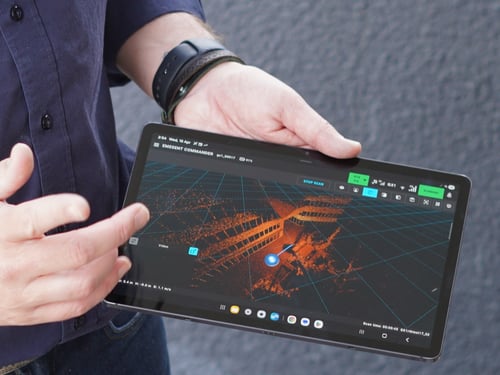 One of our core design goals from the outset was that GX1 should be accessible - not just to experienced mobile scanning professionals, but to the junior staff and newer team members that survey businesses increasingly depend on.
To support that, we invested in the Commander experience for GX1. Users will see a built-in onboarding experience to guide new users through their first scans. Real-time visibility of RTK quality, battery level, storage remaining, and camera feed is available throughout - so operators know exactly what's happening at every stage. Our goal was simple: a junior surveyor should be enabled to operate confidently within days, not weeks.
"Simplicity is key to companies who aren't surveyors — they don't want to learn how to use a total station." — Bruce Lin, Lin Trading
8. Effortless Data Offload: Small Detail, Big Impact
We paid close attention to the parts of the workflow that weren't glamorous but created daily friction. Data offload was one of them. On previous systems, camera and LiDAR data were handled separately, files were named inconsistently, and the process was slower than it needed to be. For one as-built specialist, the previous Hovermap workflow pulled the LiDAR data off in under a minute — but the separate camera files were the one place the process still bogged down.
"The only time it slows down is getting the files off the GoPro camera." — Neil Hyatt, Prairies Edge
With GX1, camera and LiDAR data offload simultaneously - via USB stick, USB-C to computer, SD card, RJ45 ethernet port and even Wi-Fi - and files are automatically organized and named sensibly for processing in Aura. It's a small detail, but it's the kind of detail that adds up across a working week.
9. The Stacked Form Factor: Every Angle Considered
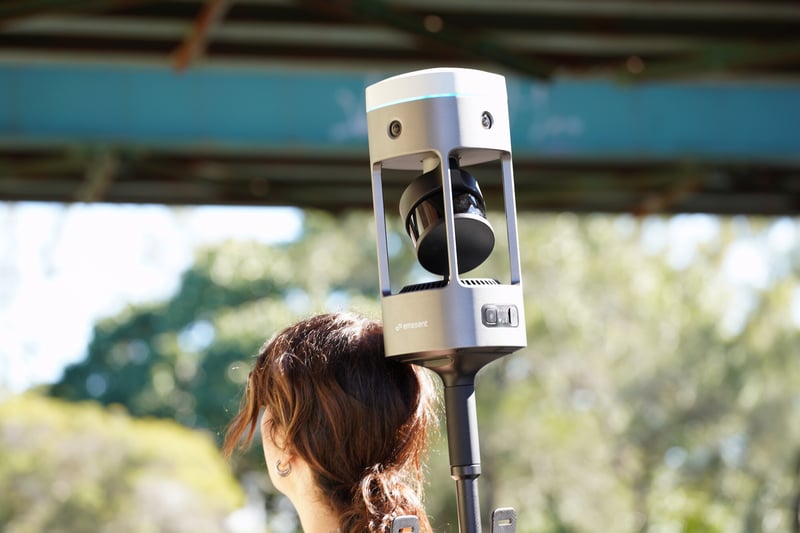 “The GX1 form factor is a good example of how function drove design. Every choice was made to improve data quality, protect key sensors, and create a product that was unmistakably built for surveyors.” - Andrew Harrison, Hardware Engineering Manager, Emesent
Hardware design is full of trade-offs. The shape of a scanner might seem like an aesthetic decision, but for GX1, every aspect of the form factor was driven by function — and getting it right required us to think carefully about what we were optimizing for.
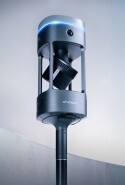
The stacked design — with the LiDAR, cameras, RTK antenna and battery arranged vertically — wasn't the obvious choice. But it solved several problems at once. Positioning the components this way protects the LiDAR without obstructing the RTK antenna, allows the cameras to capture a full 360-degree panorama without any part of the scanner getting in the way, and provides the horizontal LiDAR field of view we needed to reduce drift and improve SLAM accuracy.
It also sends a clear visual signal. GX1 is built for outdoor, professional survey work — and it looks the part. In a market where many competitors are essentially handheld indoor scanners adapted for broader use, we wanted GX1 to be immediately, visually distinct.
“It’s just a slicker unit… still the same robust SLAM and great pickups as far as point cloud density goes, but packaged in a more thoughtful and efficient way.” - Adam Wylie, Delivery Manager, Sonto
10. The Survey Pole: A Signal to Surveyors
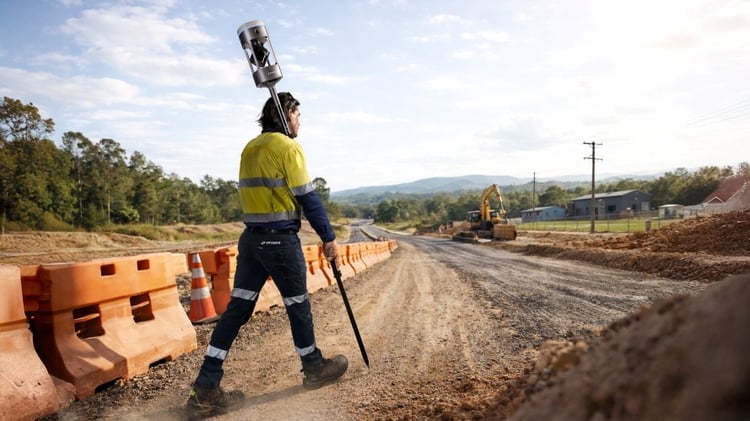 We could have built a scanner that said "we understand technology." We wanted to build one that said "we understand surveyors."
The survey pole mounting - compatible with standard 5/8" thread, designed for comfortable shoulder use, and offering the stability of a backpack with the flexibility of a handheld - is partly a practical feature and partly a statement. Surveyors work with poles. They trust poles. When they see GX1 sitting on one, they recognize it as something designed with them in mind.
"[The survey pole] is a better design for the surveyor carrying out the regular surveys. If we were doing a topographic survey, I'd prefer the pole solution." — Mark Hayes, SEP Survey
Built With You. For You.
GX1 is the product it is today because more than 25 professionals took the time to tell us, plainly and honestly, what wasn't working and what they actually needed. Every decision in this article - from the stacked form factor to the survey pole thread to the battery design - traces back to a conversation we had with someone in the field.
That's not a marketing claim. It's how we built it.
Ready to see Emesent GX1 for yourself? Request a demo now.